

Last Mile Delivery Optimization
On-Demand Delivery Explained: Importance, Benefits and Challenges


Key Takeaways
- Global on-demand delivery adoption has reached massive scale, with over 3 billion people using food delivery services and 1.2 billion using grocery delivery platforms in 2022.
- Hyperlocal delivery services excel in rapid fulfillment and customer satisfaction by focusing on limited geographic areas and prioritizing last-mile delivery over long-distance transportation.
- Key challenges in on-demand delivery include managing high daily order volumes, assigning appropriate delivery partners, and ensuring timely deliveries despite traffic and restrictions.
- Locus’s AI-driven dispatch management solution optimizes route planning, enables flexible delivery windows, and provides real-time tracking to streamline on-demand delivery operations.
Meet Sarah, a hardworking professional who returns home after a long day at work to an empty fridge. But fear not! She remembers her trusty on-demand delivery app for groceries.
With a swift tap on her smartphone, Sarah embarks on an exciting shopping adventure. She scrolls through a selection of grocery stores, adding an assortment of items to her cart.
Sarah confirms her order, summoning a flurry of notifications that set the wheels in motion. The chosen grocery store springs into action, meticulously gathering her goodies and preparing them for their journey.
The driver receives the notification, picks up the order, and heads to Sarah’s address. She tracks the delivery in real-time and prepares to receive the groceries. The driver arrives, delivers the order, and Sarah conveniently pays through the app.
Sarah effortlessly replenishes her groceries thanks to the on-demand delivery app, saving time and energy. This highlights how on-demand delivery services cater to immediate needs through technology and efficient logistics.
This is a typical account of a successful on-demand delivery experience that is the common experience of many urban populations. And while it does sound seamless in this recounting, on-demand delivery involves careful coordination and meticulous execution, ensuring a satisfying experience for customers like Sarah.
What is On Demand Delivery?
On-demand delivery is a service that fulfills immediate customer needs by providing timely and convenient delivery of goods or services. Advancements in technology and ever-evolving customer expectations have made this service gain significant popularity in recent years.
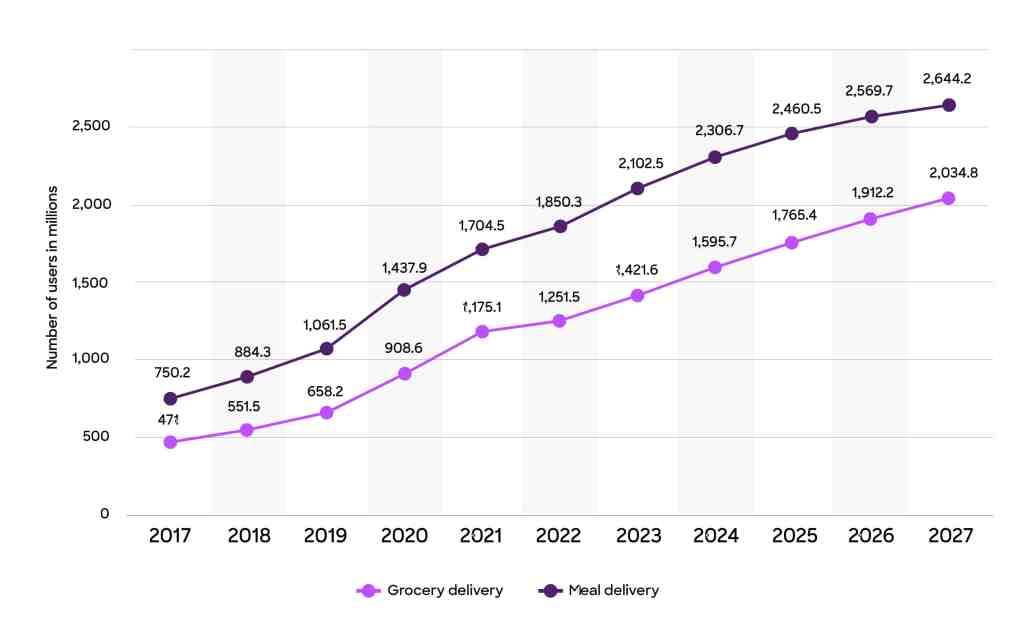
Global statistics strongly support the widespread adoption of on-demand delivery. In 2022 alone, an astonishing number of over three billion people worldwide utilized online food delivery services. Among them, approximately 1.2 billion individuals relied on grocery delivery platforms, while around 1.8 billion people opted for meal delivery services to conveniently order their desired food online.
What are the Benefits of On-demand Delivery?
On-demand delivery offers numerous advantages that can significantly enhance operational efficiency and customer satisfaction. These include customer satisfaction, cost efficiency, scalability, and real-time tracking. Below is a breakdown of each:
Customer satisfaction
On-demand delivery addresses rising customer expectations for both speed and convenience. Flexible options such as same-day service, scheduled time slots, and evening deliveries create a tailored experience that encourages repeat purchases and strengthens loyalty.
Businesses that align delivery choices with customer preferences often see higher satisfaction scores and improved retention rates.
Cost efficiency
Automating delivery functions—ranging from route optimization to task allocation—removes the bottlenecks caused by manual planning. Automation shortens delivery cycles, lowers fuel consumption through efficient routing, and reduces human error in order assignment.
As a result, businesses cut operational costs while increasing delivery accuracy and consistency.
Scalability
On-demand delivery models expand capacity without requiring major capital investments in vehicles or facilities. Cloud-based platforms make it possible to add drivers quickly, extend service coverage into new regions, and adjust capacity in line with seasonal or promotional spikes.
This elasticity allows businesses to capture additional revenue opportunities while keeping infrastructure lean.
Real-time tracking
Live tracking tools give customers visibility into their orders at every stage, from dispatch to final delivery. Providing real-time status updates not only reassures customers but also equips businesses with actionable insights to resolve delays or reroute drivers when disruptions occur. The transparency builds trust while simultaneously improving operational control.
How does on-demand delivery work?
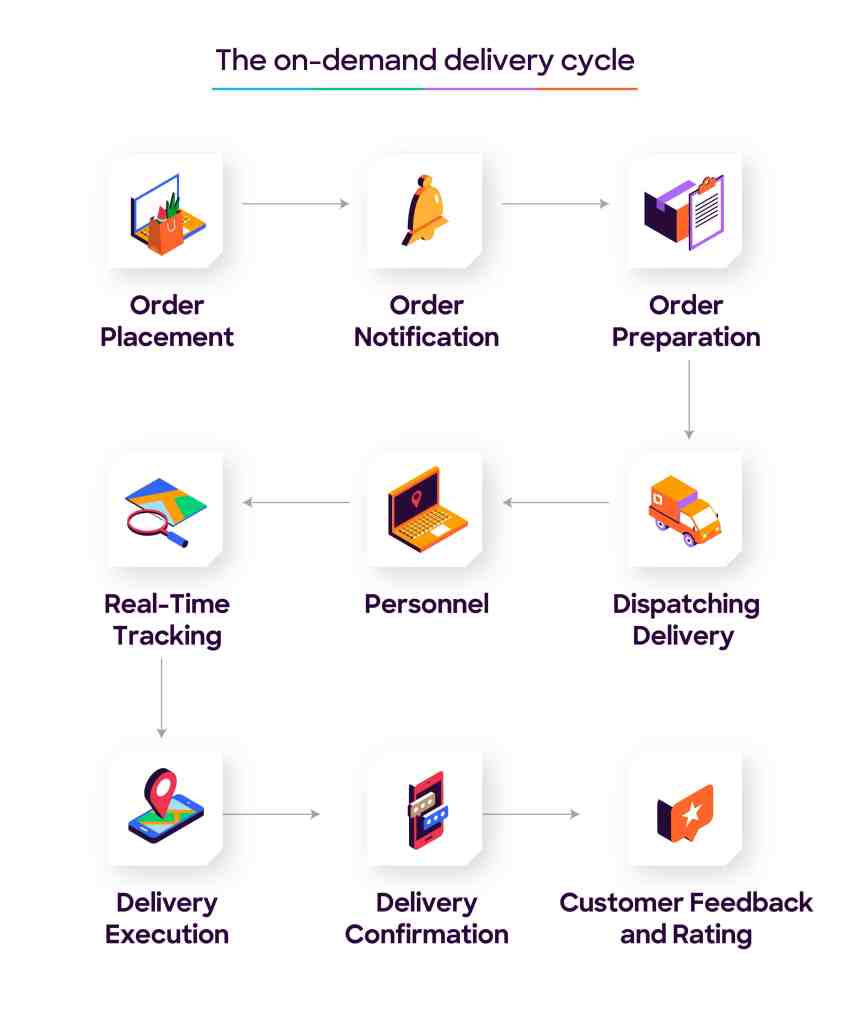
On-demand orders are usually placed via an online platform, often through a mobile app that picks up their location easily. Once customers place the order online, a notification is sent to the delivery provider or driver that’s nearest to the location and is available to fulfill the order. This can be a restaurant, grocery store, retail shop, or relevant service provider.
In an ideal scenario, the delivery provider often uses a navigation system integrated into their app to help determine the most efficient route to the customer’s location. This system also considers factors such as traffic conditions and other time constraints.
The delivery provider or driver then transports the goods or provides the service to the customer’s location. They may update the app with real-time tracking information, allowing the customer to monitor the delivery progress.
Once the delivery provider or driver reaches the customer’s location, they hand over the goods or complete the service as requested. The customer may be required to confirm receipt of the order through the app, which may trigger the payment process. After the delivery, customers can provide feedback and rate their experience through the on-demand delivery platform. This feedback helps maintain service quality and improve future operations.
Read the case study on how to increase visibility for on-demand pharma companies? Download the Case Study
Hyperlocal Delivery: The Future of On-Demand Delivery
On-demand hyperlocal deliveries are becoming increasingly popular among logistics providers and consumers. This is because these services are tailored to meet the immediate needs of local communities. Unlike non-hyperlocal deliveries, hyperlocal services can be completed within hours. In addition, the physical presence of stores and service providers in the locality enables prompt resolution of any grievances or complaints
Hyperlocal businesses operate within a limited area, and their focus is on last-mile delivery routing rather than warehousing and long-distance transportation. This makes reverse logistics a simpler process for them. As a result, on-demand businesses are well-suited for affordable and convenient services like personal homecare, food ordering, handyman services, at-home healthcare, and grocery delivery.
How to build your business around an on-demand hyperlocal delivery model?
Logistics companies and investors are keen to tap into the growing demand for on-demand hyperlocal deliveries. To build a successful business in this space, logistics companies should follow a traditional pattern of launching their business, starting with selecting an industry with high development potential, market size, and manageable competition. They should also choose a specific niche within the industry, identify their target audience, and develop a marketing strategy. Building partnerships with local businesses and delivery companies can help facilitate revenue flows based on commission from merchant partners and delivery charges from customers. Finally, finding a technology partner or on-demand app development service can help create a seamless customer experience.

What are the Biggest Challenges in On-demand Delivery Services ?
In today’s world, where people expect instant gratification and seek convenient shopping options, on-demand delivery has become a boon for customers. However, as a business, meeting the demands and ensuring timely deliveries can be a daunting task. Operating a quick commerce delivery model often entails facing real-world challenges in the last-mile delivery process, such as:
- Managing a high volume of daily orders efficiently.
- Identifying and assigning suitable delivery partners for each order.
- Ensuring on-time and complete deliveries despite various on-ground restrictions and traffic congestion.
- Effectively handling both on-demand and scheduled orders.
- Addressing on-ground delays or errors with limited visibility.
These are the obstacles that need to be overcome to optimize on-demand delivery and enhance customer satisfaction. Choosing a dispatch management solution can bridge the gaps between logistics planning and execution with accurate dispatching, order scheduling, resource allocation and real-time tracking of orders. This is how it can manage the day-to-day dispatching of hundreds of orders:
Streamlining order planning and execution: Dealing with the high volume of daily orders in on-demand delivery can be a major challenge. Determining the right person for each task and identifying the most efficient route to deliver to customers promptly are crucial considerations. Locus offers an AI-driven dispatch planning solution that simplifies your day-to-day dispatch operations. It ensures timely order scheduling, efficient resource allocation, and optimized route planning, allowing you to handle your deliveries with ease.
Finding convenient time slots: Locus’ time-slot management system allows your logistics managers to plan last-mile operations more systematically. The Delivery Linked Checkout feature helps to unlock new revenue with premium fulfillment options, where customers can pick from multiple delivery windows—ten minutes, two hours, same day, next day—help businesses capture a wide range of customers by meeting their daily requirements.
Personalizing customer experience: With Locus’ advanced data analytics and insights, you can offer customers better, more personalized delivery services. It also allows decision-makers to stay on top of market trends.
Real-time tracking of orders: Time is of essence in on-demand delivery and Locus’ real-time visibility helps in tracking orders and providing live status updates to customers, improving supply chain visibility and keeping customers satisfied. Live updates and predictive alerts keep logistics managers on the top of ongoing deliveries and help avoid unexpected delays.
On-demand delivery is revolutionizing industries, ushering in a monumental shift that demands businesses to rise to the challenge. To thrive in this dynamic landscape, leveraging a robust dispatch management solution becomes. By optimizing last-mile deliveries, businesses can not only conquer the game but also proactively stay ahead of the ever-evolving curve.
Enabling On-Demand Delivery with Locus’ Dispatch Management Platform
Choosing the right dispatch management solution is key to bridging the gap between logistics planning and execution. It helps optimize dispatching, order scheduling, resource allocation, and real-time tracking. Here’s how Locus’ Dispatch Management Platform simplifies the day-to-day management of hundreds of orders:
1. Streamlining Order Planning and Execution
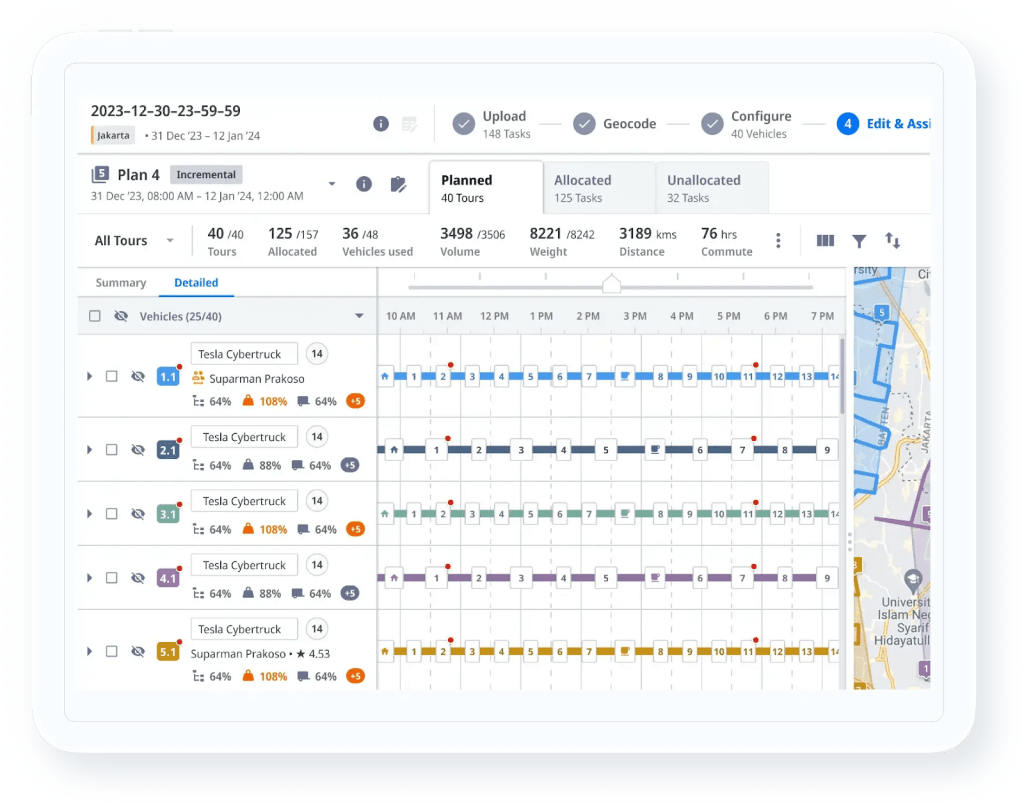
Managing a high volume of daily orders is one of the biggest challenges in on-demand delivery. Identifying the right resources for each task and ensuring the most efficient route is crucial.
Locus’ AI-driven dispatch planning solution streamlines these processes, ensuring timely order scheduling, efficient resource allocation, and optimized route planning. This enables businesses to manage deliveries with ease and precision.
2. Finding Convenient Time Slots
Locus’ time-slot management system enables logistics managers to plan last-mile operations more effectively. The Delivery Linked Checkout feature unlocks new revenue streams by offering premium fulfillment options, such as ten-minute, two-hour, same-day, and next-day delivery windows.
This flexibility helps businesses cater to diverse customer needs and meet the demand for faster deliveries.
3. Personalizing Customer Experience

By adopting advanced data analytics and insights, Locus empowers businesses to offer more personalized delivery services. With these insights, decision-makers can understand market trends and customer preferences, further enhancing the delivery experience and ensuring it meets customer expectations.
4. Real-Time Tracking of Orders

In on-demand delivery, real-time tracking is essential. Locus provides full visibility into the delivery process, offering live status updates to customers and logistics managers. Predictive alerts help prevent delays and ensure timely deliveries, while improving overall supply chain visibility and customer satisfaction.
On-demand delivery is transforming industries, and businesses must adapt to stay competitive. With Locus’ Dispatch Management Platform, businesses can not only optimize their last-mile deliveries but also proactively navigate the evolving landscape, ensuring they stay ahead of the curve.
Conclusion
Locus’ Dispatch Management Platform is an indispensable tool for businesses seeking to streamline their on-demand delivery services. By automating key tasks, optimizing routes, and offering real-time tracking, it enables companies to provide superior customer experiences while enhancing operational efficiency. With Locus, businesses can scale their operations, reduce costs, and stay ahead in the competitive world of on-demand delivery.

Retail & CPG
Can Retailers Reinvent the Last Mile? The Trillion-Dollar Question

May 9, 2023
Key Takeaways US retail e-commerce is on a meteoric rise, thanks to the high levels of convenience that comes with the experience. Statista forecasts that its revenue will hit a whopping $1 trillion in 2023 and skyrocket to $1.5 trillion by 2027. That’s an enormous chunk of change, and it underscores the importance of optimizing […]
Read more
Gartner
Gartner Supply Chain Symposium/Xpo™ 2023 Highlights: A Human-Centric Approach to Unlocking Productivity

May 12, 2023
In the Gartner Supply Chain Symposium, industry analysts and speakers shared their perspectives on logistics automation, last-mile optimization and AI.
Read moreInsights Worth Your Time


SUBSCRIBE TO OUR NEWSLETTER
Stay up to date with the latest marketing, sales, and service tips and news
On-Demand Delivery Explained: Importance, Benefits and Challenges