

Featured
Hub and Spoke Distribution Model: A Logistics Guide

Key Takeaways
- The hub and spoke distribution model centralizes warehousing around strategic hubs, enabling more efficient deliveries to multiple locations while reducing transportation costs compared to point-to-point distribution.
- Last-mile delivery costs account for 53% of shipping expenses, making network optimization crucial for businesses to maintain profitability while meeting customer demands for faster delivery.
- The model improves workforce productivity by allowing delivery agents to plan routes around centralized hubs and complete deliveries systematically within specific geographical zones.
- Locus’s AI-powered route optimization technology enhances hub and spoke operations by automatically planning efficient delivery routes while considering time windows, traffic patterns, and ground constraints.
In an environment where every customer matters, know how a hub and spoke model can satisfy consumers with faster deliveries.

What is the Hub and Spoke Distribution Model?
As the name suggests, a hub and spoke model is a centralized warehousing and shipment system that resembles the structure of a bicycle wheel. The center of the wheel is the hub or a distribution center and each spoke represents a direction of delivery.
In a point-to-point distribution model, packages typically move between points A to B, C, D, or E based on delivery requirements and inventory availability at that time. There is no centralized warehouse or distribution center, which leads to inefficient distributions and higher logistical costs.

On the other hand, in a hub and spoke system, distribution centers or warehouses are strategically placed within the city from where reaching out to multiple delivery locations within an area is possible with the most optimal travel distance and time.
The hub and spoke model allows greater flexibility and offers a more efficient connection system, consolidating the efforts of hundreds of drivers, and delivery executives to one dedicated center, making it a popular delivery network system among modern supply chain enterprises.
Why is Hub and Spoke Distribution Model Important?
The short answer: Faster deliveries at lower costs. Globally, customer satisfaction is defined by speed and convenience more than anything else today. Consumers want great products at low prices delivered to their doorsteps in the shortest timeframe possible. In a consumer survey conducted by PwC, 41% of consumers were even willing to pay premium rates for fast delivery services.
Enterprises across varied industries including food, groceries, pharma, retail, FMCG, 3PL, and e-commerce are now focusing on faster last-mile fulfillment methods to get an edge over competitors. According to a McKinsey report, some have even been aiming to make same-day delivery a market standard. Needless to say, efficient logistics has become a key differentiator for all kinds of delivery businesses.
But as logistics comes to the forefront of supply chain operations, businesses cannot afford to bear the heavy costs of transportation, warehousing, and inventory management to be able to reach the customer faster. This is especially true for the last-mile, given that it accounts for around 53 percent of shipping costs.
It is therefore important to make cost-efficient moves, faster. Network optimization is a key strategy for modern supply chain enterprises to stand out in the market. Over the years, supply chain enterprises have embraced tech in logistics and adopted smarter practices such as the hub and spoke distribution model to reduce operating costs and speed up deliveries.
How does the hub-and-spoke distribution model work?
At its core, the hub-and-spoke distribution model relies on a central warehouse or distribution center (DC) that acts as the “hub.” All shipments flow through this hub before being sent to regional centers or final delivery points. Some enterprises even operate multiple hubs to serve different geographic areas efficiently.
The working mechanism can be broken into clear stages:
- Centralized intake of shipments: Products from manufacturers or suppliers arrive at the hub, where they are sorted and consolidated.
- Transfer to regional hubs: Goods are dispatched from the main hub to regional warehouses or secondary hubs closer to customers. For example, products from Hub A may be shipped to Hub B for localized distribution.
- Spoke-level distribution: Delivery agents at the regional hub complete shorter trips to customer addresses or retail stores. By covering defined zones, they reduce vehicle mileage and avoid empty backhauls.
The structure limits unnecessary long-haul trips, speeds up delivery timelines, and reduces transportation costs by maximizing vehicle utilization.
In practice, this model allows companies to:
- Shorten delivery distances by segmenting routes around regional hubs
- Increase workforce productivity with route clusters designed around specific zones
- Maintain stock visibility and reduce logistical waste through centralized oversight
When paired with AI-driven logistics tools such as Locus’s route optimization software, the model becomes even more powerful. Enterprises can automatically plan the fastest routes, respect customer time windows, and adapt to real-world constraints like traffic or weather.
Advantages of the Hub and Spoke Distribution Model
Simplifies shipment processes
Since all shipments in a day are typically picked up from a designated hub, it is easy for logistics managers to plan daily dispatches effectively and assign delivery duties to agents in a more systematic manner based on their geographical knowledge and preferences. It is also easy to load and unload shipments from the centralized point and maintain the right levels of stock to ensure constant supplies within a particular area.
Improves workforce productivity
A day in the life of a delivery agent is quite hectic with multiple orders to be delivered across multiple locations. Running around from one end to the other is not easy, especially with on-ground constraints such as traffic and time-based deliveries. A hub n spoke model allows delivery partners to plan their daily delivery routes around one hub, finish deliveries in a particular region, and then move on to another hub for any on-demand or extra deliveries. It improves the productivity of on-ground executives and allows them to meet service levels effectively.
How Locus is managing customer-preferred time windows for its clients?
Download Case Study Now!
Optimizes route planning and faster deliveries
As freight moves along the spokes of the bicycle wheel, a hub and spoke network allows the most optimal planning of delivery routes. Logistics managers can plan the shortest route, considering customer-preferred delivery timings, peak traffic hours, and other ground restrictions. This ensures that last-mile delivery operations are carried out faster and more efficiently, leading to improved customer satisfaction.
Brings down logistical costs
The hub and spoke delivery model is cost-effective for supply chain enterprises in a number of ways. Taking the most efficient routing not only speeds up last-mile deliveries but also saves fuel costs dramatically due to the lesser miles traveled. The hub and spoke system also limit the number of distribution centers within a city, leading to reduced cost of inventory management as well.
Is a Hub and Spoke model ideal for your supply chain?
Many companies are now adopting the hub and spoke structure for inter-city and intra-city order fulfillment. However, as a decision-maker in logistics, you must understand whether it’s an ideal match for your supply chain.
The decision completely depends on the nature of your business and your size of operations. For instance, it is most beneficial for E-commerce or 3PL companies with high-density orders in specific regions. Hub and spoke networks are also best-suited for companies in the food delivery and hyperlocal delivery market with bulk orders within a fixed radius.
All in all, the hub and spoke model is certainly a more flexible and profitable distribution network ensuring a smooth flow of goods compared to the old-school point-to-point model. It is a great option for supply chain enterprises with sizeable shipments and delivery demands on a day-to-day basis.
Locus helps businesses in the supply chain improve logistics operations with Artificial Intelligence.
Schedule free demo with Locus experts and achieve end-to-end route optimization in your supply chain.
Download E-Book on “Change is the Only Constant in Last-Mile Delivery“
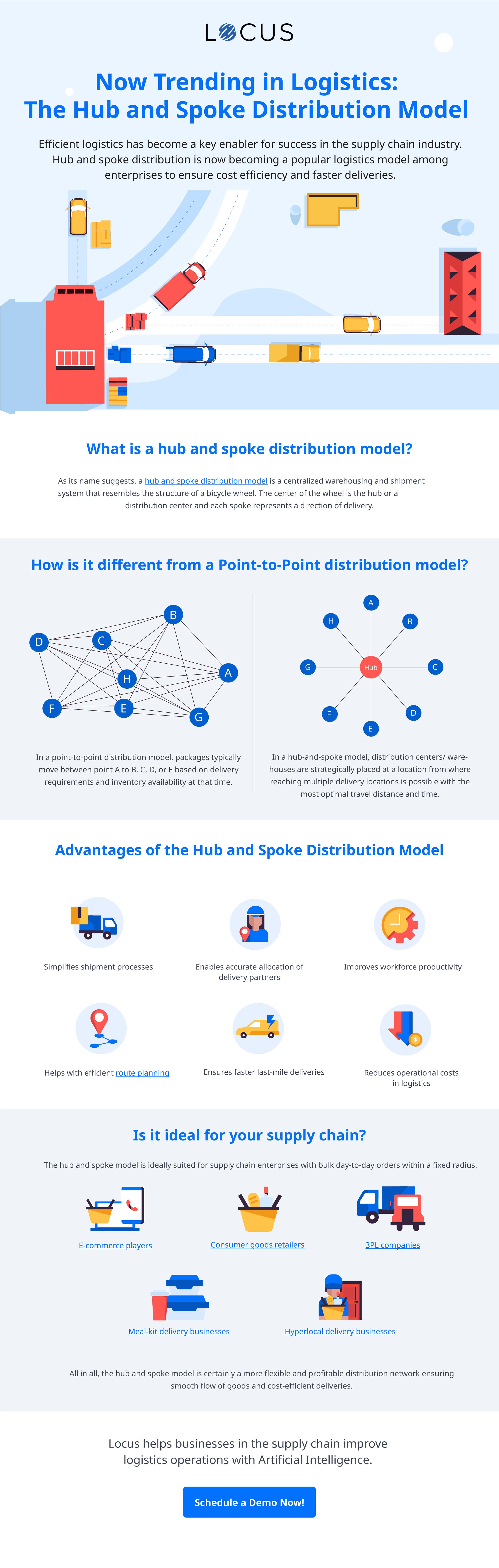
Share this infographic by using this embed code:
<a href="https://blog.locus.sh/hub-and-spoke-distribution-model-in-modern-supply-chains/" target="_blank" style="text-align: center; display: block;"><img src="https://locus.sh/assets/img/infographic/hub-and-spoke/hub-and-spoke-infographics.jpg" alt="Now Trending in Logistics: The Hub and Spoke Distribution Model" style="width:100%;height:auto;max-width:750px;margin:auto;"></a><br/>Infographic by <a href="https://locus.sh/">Locus</a>Frequently Asked Questions (FAQs)
What is the hub and spoke distribution model?
The hub and spoke distribution model is a centralized warehousing and shipment system where a distribution center (the hub) is strategically located to enable efficient delivery to multiple locations (the spokes) within a region. Packages are consolidated at the hub and then distributed along the spokes or delivery routes, optimizing travel distance and time.
Why is the hub and spoke model advantageous for supply chain enterprises?
The hub and spoke model simplifies shipment processes, improves workforce productivity, optimizes route planning for faster deliveries, and brings down overall logistical costs. By consolidating efforts at a central hub, it enables more systematic dispatching, efficient route optimization, reduced fuel costs from shorter travel distances, and lower inventory management expenses.
How does the hub and spoke model improve last-mile delivery operations?
With shipments consolidated at a central hub, the hub and spoke model allows logistics managers to plan the shortest and most optimal delivery routes considering factors like customer time preferences, traffic conditions, and other constraints. This ensures last-mile deliveries are carried out faster and more efficiently, leading to improved customer satisfaction.
When is the hub and spoke distribution model ideal for a supply chain business?
The hub and spoke model is most beneficial for businesses with high-density orders within specific regions, such as e-commerce, 3PLs, food delivery, and hyperlocal delivery services with bulk orders within a fixed radius. It works well for companies with sizable daily shipments and delivery demands across a concentrated area.
How can Locus’s solutions help optimize the hub and spoke distribution model?
Locus’s AI-powered routing and scheduling solutions can significantly enhance the efficiency of hub and spoke operations. Locus’s algorithms enable intelligent route optimization considering multiple real-world constraints, ensuring the fastest and most cost-effective routes from the hub. Its machine learning capabilities also help predict demand accurately for strategic hub placement. With end-to-end visibility and analytics, Locus empowers businesses to continuously refine their hub and spoke networks for peak performance.

Fleet Optimization
What is Fleet Utilization? Key Metrics & Importance in 2025

May 31, 2025
Learn to increase fleet utilization, cut fuel costs, and boost profitability with real-time tracking, metrics, and automation tools effortlessly in 2025
Read more
Last Mile Delivery Optimization
Farmer to Consumer Supply Chain Driven by Logistics Tech
May 31, 2025
Key Takeaways From farm to fork, the agri-foods supply chain is typically a long journey with multiple touchpoints. Once harvested in a farmer’s barn, the produce is first sent to primary processors, who clean, cut, package, and sort the crops into appropriate sizes for sale. From the processor, it then moves to wholesalers who distribute […]
Read moreInsights Worth Your Time


SUBSCRIBE TO OUR NEWSLETTER
Stay up to date with the latest marketing, sales, and service tips and news
Hub and Spoke Distribution Model: A Logistics Guide