

Logistics Software
Legacy Out, Intelligence In: The Great Realignment of Supply Chain Tech

Key Takeaways
- Enterprise software spending is shifting dramatically, with AI and machine learning now central to supply chain operations rather than peripheral considerations.
- New AI-powered logistics platforms are winning 53% of GenAI contracts over legacy vendors by delivering faster deployments and measurable business impact.
- Route optimization, predictive ETAs, asset health management, and driver engagement are proving to be the most successful practical applications of AI in logistics.
- Locus’s AI-led logistics platform enables businesses to integrate smart routing and delivery orchestration while maintaining operational flexibility and carrier independence.
Many recall 2020 as a disruption to logistics, but it ultimately became a defining reset.
The pandemic’s surge in parcel volumes wasn’t a temporary shift, it recalibrated expectations. B2C surged first, but B2B wasn’t far behind.

Four years on, volumes across both categories remain 20–26% higher than pre-pandemic levels. It’s safe to say that this is the new operating baseline. What began as an emergency response has become structural behavior. And that shift is reshaping how enterprises think about logistics, technology, and transformation.
Building the Foundation First

Between 2021 and 2023, CXOs concentrated enterprise software budgets on IT infrastructure and security, with 55% of spending directed toward foundational tech like cloud architecture and cyber protection. In comparison, only 25% was allocated to SCM and ERP upgrades.
The logic was sound: in an era of remote operations and rising risk, leaders prioritized stability, access, and control over transformation. First, they secured the pipes and now, they’re upgrading the engine.
Software Budgets Are Finally Catching Up
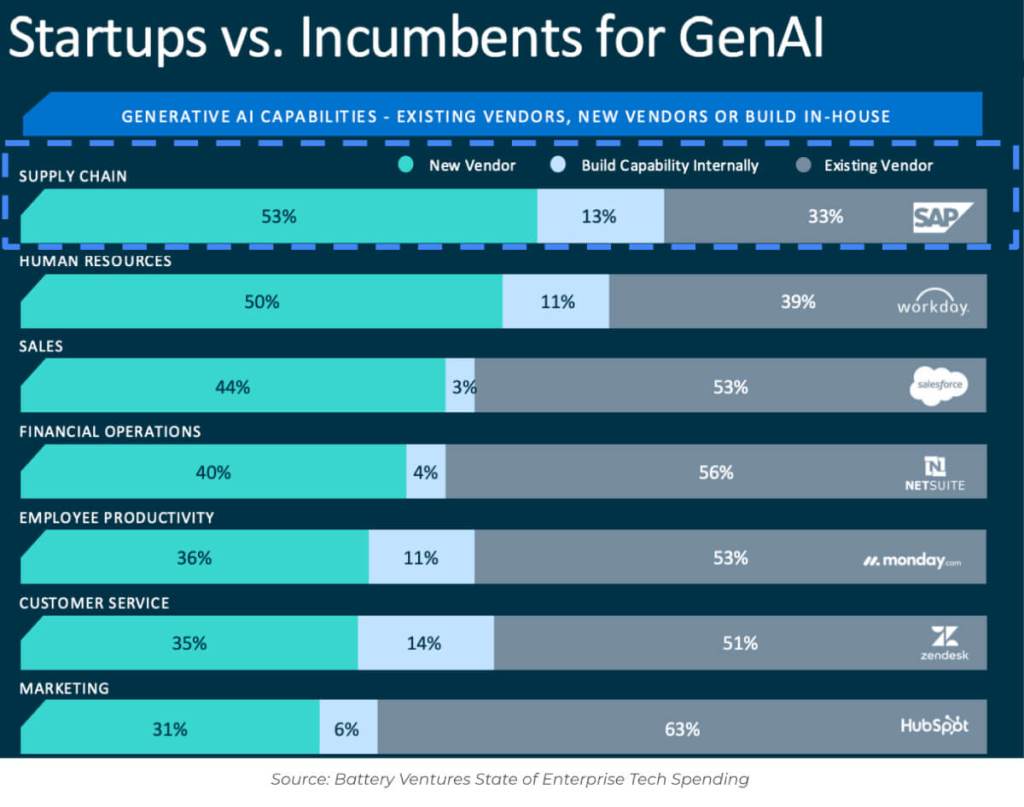
Recent research from Battery Ventures highlights a powerful inflection point: AI and machine learning are no longer fringe considerations, they’re central to how enterprises are reallocating their software spend. And nowhere is this rebalancing more pronounced than in supply chain operations.
Today, the supply chain category leads in incumbent tech replacement, signaling that decision-makers are no longer content with rigid, decades-old systems. They’re seeking tools that adapt in real time, integrate modularly, and deliver business outcomes, not just feature checklists.
A Quiet Power Shift in the Logistics Stack
Enterprise buyers are increasingly turning to newer players. In fact, 53% of new GenAI supply chain contracts are now awarded to startups, displacing legacy vendors that once dominated the landscape.
These newer platforms aren’t winning on promise alone, they’re delivering faster deployments, modular integrations, and tangible impact. In a sector where timelines are tight and margins tighter, this speed-to-value equation is compelling.
And for logistics consultants, this shift creates a new type of mandate: guide clients on what truly delivers
Where AI Is Already Paying Off

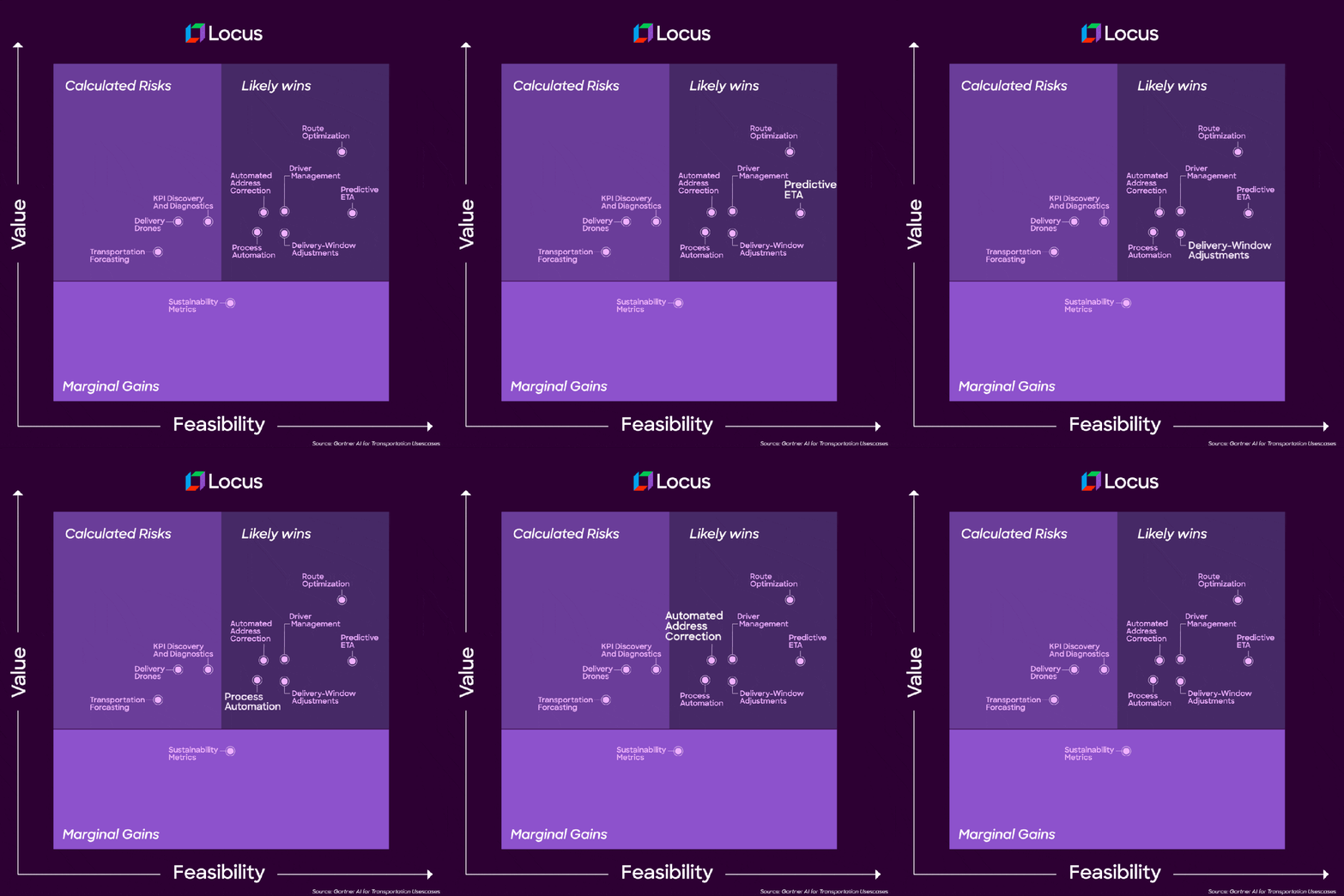
AI has moved past the experimentation phase in logistics. Certain applications are already proving both feasible and valuable:
- Route Optimization: Adaptive routing that reduces fuel use and late deliveries by dynamically responding to traffic, weather, and real-time constraints.
- Predictive ETAs: Moving beyond static SLAs to intelligent, data-driven arrival forecasting grounded in real-time signals.
- Asset Health Management: AI-driven diagnostics that preempt breakdowns, extend asset life, and minimize disruption.
- Driver Engagement & Retention: Smarter task allocation and performance transparency to build morale, reduce attrition, and stabilize operational throughput.
Each of these use cases is being applied today: on the ground, in motion, and at scale.
Why Consultants Have a Front-Row Seat
For consultants and strategic advisors, this moment is significant. With new tools entering the supply chain ecosystem, clients are looking for guidance rooted in outcomes, not just implementation timelines.
The research slide underlines this: forward-looking consultants are the ones connecting C-suite ambitions with operational traction. They’re helping enterprises:
- Deploy tools that integrate easily into existing workflows
- Prioritize AI use cases that create measurable, near-term value
- Move confidently away from vendor lock-in and toward platforms built for responsiveness
This goes beyond a technology upgrade; it reimagines what modern logistics execution should be.
In Closing
The supply chain is evolving; quietly, swiftly, and in ways that reward precision over legacy.
At Locus, we’re building for that future. Our AI-led logistics platform helps businesses plan smarter, route faster, orchestrate deliveries across carriers, and build experiences that win loyalty.

General
Ghibli Gone Wrong? Here’s Why

May 13, 2025
Ghibli trend might be lighthearted fun, but at the same time reveals something fundamental about how AI learns, scales, & where it stumbles.
Read more
Blog
Logistics Transportation Cost: Types & How to Calculate

May 30, 2025
Key Takeaways In the midst of an outdoor movie screening of “Trucks,” a film about a town overrun by driverless trucks, a person from the crowd, who runs a transport service company, jokingly mentioned that while phantoms could handle the task, they couldn’t effectively control transportation costs. Want to know how to control transportation costs, […]
Read moreInsights Worth Your Time


SUBSCRIBE TO OUR NEWSLETTER
Stay up to date with the latest marketing, sales, and service tips and news
Legacy Out, Intelligence In: The Great Realignment of Supply Chain Tech