

General
Economic Order Quantity (EOQ): Definition & Key Challenges


Key Takeaways
- Economic Order Quantity (EOQ) helps businesses balance inventory holding and ordering costs while minimizing stockouts by calculating optimal order quantities for each product.
- Seasonal demand fluctuations and lack of real-time inventory data pose major challenges to EOQ implementation, as the model assumes constant demand patterns.
- The EOQ formula overlooks critical factors like supplier lead times, current stock levels, and business growth phases, potentially leading to inventory imbalances.
- Locus.sh’s AI-powered platform enhances EOQ calculations by incorporating real-time data analytics and dynamic demand forecasting to optimize inventory management decisions.
Since the start of 2023, we have been witnessing two news stories in the world of supply chain and logistics. One Walmart’s new Associate-to-Driver program launched at the beginning of this year. And another one is Amazon opening up new distribution centers and partnering with smaller carriers.
There’s just one reason behind both these stories – the rapid rise in online shopping. This rising number of customers doing online shopping has been attributed to increased customer expectations on direct home deliveries.
In a survey conducted in 2022 of US consumers, 55% of them stated that direct delivery to home is the biggest driver of online purchase. With last-mile delivery incurring 53% of total shipping costs, retail businesses should fulfill these rising customer expectations and simultaneously have a rigorous control over costs. But how’s it possible?
There are many levers that help retail businesses control the last-mile delivery costs. One such important lever is Economic Order Quantity. Let’s dive in!
What is Economic Order Quantity?
Ford Whitman Harris first published the model of Economic Order Quantity in a paper Factory, The Magazine of Management, in 1913. Despite being disseminated widely, it was unnoticed for many years until it was rediscovered in 1988. This model became dominant for order-quantity analysis in the study of supply chains.
Economic Order Quantity (EOQ) is a model businesses use in their supply chain and logistics operations. It is an ideal order quantity that a company needs to satisfy a given level of demand, minimize inventory costs, and avoid stockouts. It implies the number of units businesses should add to their inventory with every purchase order.
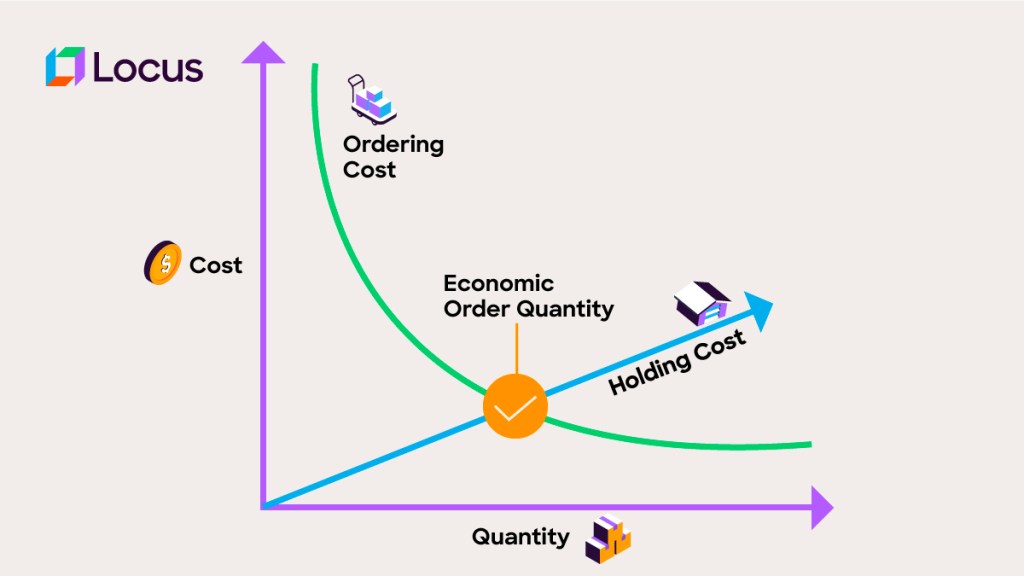
Economic Order Quantity is a simple inventory planning model that enables businesses to balance holding costs and ordering costs. It helps companies to answer two crucial questions:
- How much to order? – Volume
- When to order? – Frequency
What is the formula for calculating Economic Order Quantity?
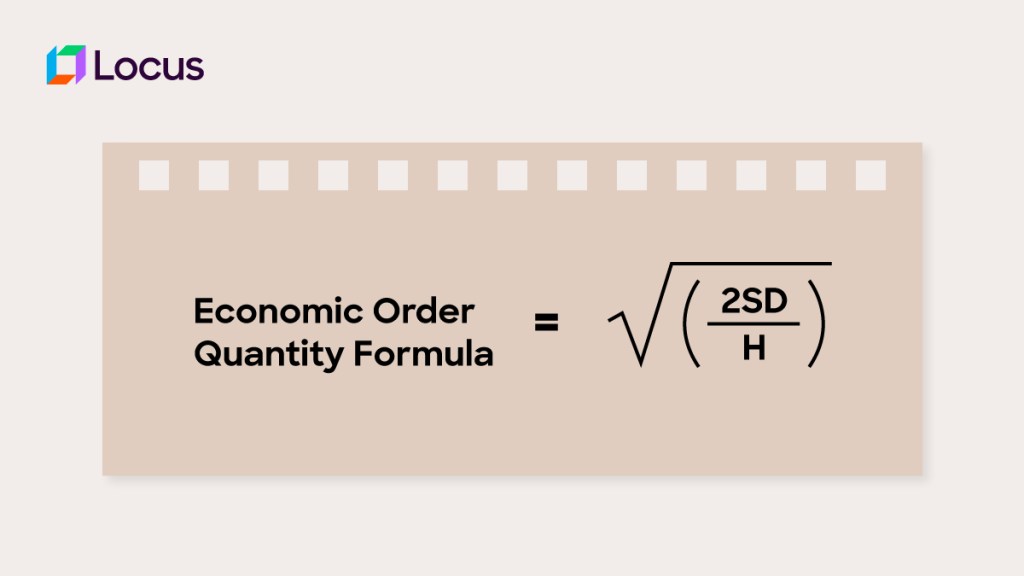
S = Setup costs
S refers to the setup costs or the ordering costs. It is the amount of money taken to order an inventory, ship, and handle it so that it can be distributed to your customers.
D = Demand rate
D is the customer demand or the number of units customers order. Demand in units is expressed in a specific timeframe, like a month, quarter, or year. Mainly, we calculate demand for a year (How many units of a product do customers order in a year?)
H = Holding costs per unit
H is nothing but holding costs. It is the cost incurred to store an inventory. We calculate the holding costs annually on a per-unit basis. It tries to answer a critical question: how much will it cost per unit to store for a year? These holding costs include:
- Employee Salaries
- Insurance
- Damage
- Opportunity costs
- Depreciation costs
- Equipment
- Related inventory expenses
- Warehousing costs
The formula for calculating holding costs is:
Cost of Storage / Total Annual Inventory Value * 100
All the aforementioned costs are total storage costs. The total annual inventory value is the total monetary value of inventory.
Example of Economic Order Quantity (EOQ)
Say that a retail clothing outlet sells 2,000 formal shirts for men, women, and children. The outlet incurs $10 to hold a single shirt in the inventory (holding cost), and the fixed cost to place the order is $5.
Let’s apply the EOQ formula here on this problem √2 * 2000 * 5 / 10.
Applying the EOQ formula from above, we get 48.7. So, the ideal order size to minimize holding costs and meet customer demand is slightly more than 48 shirts.
Want to find out how to achieve optimal safety stock level in your supply chain?
Importance of Calculating EOQ
There are some benefits your businesses could gain by calculating Economic Order Quantity. Let’s find out.
1. Minimize holding and ordering costs
The cost of ordering falls due to economies of scale when businesses increase the ordering volume. But this leads to an increase in the inventory’s holding costs as the inventory size is large. This is where EOQ has significance. With the help of EOQ, businesses can reduce these inversely related costs and fulfill their customer demand.
2. Reduce the likelihood of stockouts
If your business reduces the ordering size to reduce the holding costs, it might lead to stockouts. When your company does not have enough quantity of goods when customers are ready to buy, they find another store to get their desired product which results in losing customers. So, EOQ helps companies minimize the likelihood of stockouts.
3. Eliminate overstocking
Overstocking is when your business has more products than you sell. In these situations, the storage fees increase, resulting in higher holding costs. Using EOQ, your companies can find that middle ground between overstocking and understocking and determine how much product should be ordered at different inventory levels.
Challenges of using Economic Order Quantity as a metric
Economic Order Quantity provides businesses with the optimal reorder quantities to minimize costs. There are no two ways about it. But there are practical difficulties when companies rely entirely on EOQ as the sole metric for maintaining optimal inventory levels.
1. Lack of real-time data on inventory
The lack of accurate and sufficient data on demand rate, holding costs, and ordering costs can make it challenging to calculate EOQ. It’s complicated to get precise data for products that are new or have fluctuations in demand.
Inaccurate data leads to a wrong amount of inventory that would lead to a stockout or overstocking decisions. These decisions can negatively affect customer experience and reduce the revenue for your company.
2. Inability to consider the seasonality of demand
EOQ calculations cannot validate the inventory requirements for products with seasonal demand. For products with seasonal fluctuations in demand, like the holiday season or weather-related demand, we can’t use one simple EOQ measure at the beginning of the year and expect it to hold.
EOQ for every product varies based on demand, and no one order quantity can be applied across inventory. Regularly adjusting EOQ for seasonality is necessary to avoid stockouts and excess inventory.
3. Cost of stockouts
Stockouts lead to decreased sales, reduced customer satisfaction, and increased ordering and holding costs. Every stockout can significantly impact EOQ calculation accuracy and disrupt the order placement process. So, EOQ does not consider the cost of stockouts for businesses.
Say, a retail outlet is experiencing stockouts frequently. With these frequent stockouts, it should revise the EOQ calculations to consider the cost of stockouts and maintain the optimal stock levels.
4. Fails to consider current stock levels
Just imagine the customer demand for a product drops between placing one order and the next. In this situation, if your business simply reorders items solely based on the EOQ formula, it could lead to excess inventory building up in the warehouse.
The major drawback of the EOQ model is that it does not consider the current stock levels in the inventory. And the demand for certain items might vary from one warehouse to another. So, reordering items with the EOQ metric will lead to a wastage of resources if items are in different stocking locations.
5. Fails to consider variation in fixed costs
Another defect in the EOQ model is that it treats all inventory items equally, irrespective of the value it adds to the business. It assumes that all items in the inventory have fixed costs that never fluctuate.
Using EOQ as the only metric blindly makes your business waste its valuable space on items that are not required. It’s necessary to prioritize items with higher demand and more valuable Stock Keeping Units (SKUs) to maintain customer service levels.
6. Assumes immediate availability of stock
Say, a retail outlet reorders 100 shirts from a supplier based on its EOQ model. There will be stockouts if these 100 shirts don’t reach them in two days. But the supplier needs five business days or a lead time of five days to deliver the shirts to that retail outlet.
Another major drawback of EOQ is that it does not consider the supplier lead time to order items. It only tells us how many items to order based on the demand.
7. Business growth
When a company grows, its economies of scale grow, resulting in changes to EOQ. Likewise, companies need to adjust their inventory levels during business contractions to avoid excess inventory.
The EOQ model does not consider the growth or contraction of business. There will be an inventory imbalance and increased costs if companies use EOQ without considering their expansion or contraction phase.
8. Fails to consider inventory management strategies
The EOQ model does not take into account the company strategies. When a company adopts a Just-In-Time Inventory (JIT) management strategy, the EOQ calculation will become irrelevant. This is because JIT aims to produce and deliver products at a time when customers demand them. So, the inventory management strategy decides whether the EOQ metric is relevant.
EOQ is Important, but Unit Economics is Super-Critical!
Are we able to generate higher profits from a customer than the cost incurred to acquire them?
This is the question that every retail business involved in last-mile delivery needs to seriously answer. Economic Order of Quantity is just the tip of the iceberg that helps businesses benchmark the costs and keep them under control. The lion’s share that helps us find the right answer for this question is Unit Economics.
Unit Economics helps the business to find profitability for each delivery transaction. This helps businesses to benchmark the delivery performance, make the right decisions, and make an effective long-term strategic plan for upcoming deliveries. It also enables businesses to come up with the optimal pricing of orders, and minimize the inflated costs due to supply chain mismanagement.
Are you willing to improve unit economics and multiply revenue opportunities from your last mile?
References:
https://pubsonline.informs.org/doi/10.1287/opre.38.6.937
https://corporate.walmart.com/newsroom/2023/01/18/with-walmarts-new-associate-to-driver-program-the-wheel-is-within-reach
https://www.pymnts.com/news/delivery/2023/walmart-amazon-and-others-start-2023-by-increasing-last-mile-delivery-options/
https://www.statista.com/forecasts/997240/drivers-of-online-purchases-in-the-us

General
Logistics Route Planning: Everything You Need To Know [2025]

Jun 30, 2025
Enhance your delivery efficiency with proven logistics route planning strategies. Discover actionable tips to optimize your operations—read the article now!
Read more
Mid-mile Logistics
Mid-Mile Logistics Challenges: How To Overcome them?
Jul 1, 2025
Key Takeaways In the intricate world of business and supply chains, middle-mile logistics emerges as the linchpin that governs the very pace of the process. It’s the domain where precision and coordination between delivery drivers and operation managers become paramount, for it’s here that products embark on a journey to multiple fulfillment locations, ultimately determining […]
Read moreInsights Worth Your Time


SUBSCRIBE TO OUR NEWSLETTER
Stay up to date with the latest marketing, sales, and service tips and news
Economic Order Quantity (EOQ): Definition & Key Challenges