

AI in Action at Locus
AI in Logistics: What is It? Why It Matters in 2025?


Key Takeaways
- Companies with mature AI-enabled supply chains are 23% more profitable and six times more likely to create business value through their logistics operations.
- Manual logistics operations are typically inefficient and error-prone, making AI-powered automation essential for achieving scalability and operational excellence across the fulfillment chain.
- Data-driven logistics solutions that learn from historical datasets enable more precise delivery planning, leading to 99.5% on-time delivery rates and improved customer experience.
- Locus’s AI-powered solutions have enabled over 1.2 billion deliveries globally, resulting in $303 million in logistics cost savings and 14.4 million kg reduction in greenhouse gas emissions.
This is the first in a series of blogs that will showcase how Locus has been able to leverage AI and ML’s unique capabilities to deliver real-world growth. We will cover our areas of focus, and in subsequent blogs, go deeper into how we use AI in various parts of the fulfillment chain to bring about real business value.
If you do a little digging, you can see that have been thinking about and developing Artificial Intelligence (AI) and Machine Learning (ML) for nearly 70 years!
However, it was only in the past two years, with the introduction of Generative AI and Large Language Models like (LLMs) like ChatGPT that we are seeing mainstream adoption.
When it comes to AI in logistics and supply chain management, the data is clear on this. According to a study by Accenture, businesses with most mature supply chains are 23% more profitable, and they are six times more likely to use AI and generative AI widely for creating business value in their logistics and supply chain operations.
While the overall optimism around deployment of technology, embellished with AI capabilities, is strong, clarity on its exact use cases is still highly sought after.
This the first in a series of blogs that will showcase how Locus has been able to leverage AI and ML’s unique capabilities to deliver real-world growth. We will cover our areas of focus, and in subsequent blogs, go deeper into how we use AI in various parts of the fulfillment chain to bring about real business value.
Sticking to the fundamentals of innovation and value creation:
For nearly a decade, Locus has been creating cutting-edge solutions that powered over 1.2 billion deliveries across the globe, resulting in $303 million saved in logistics costs, 82 million miles saved in transit time, leading to over 14.4 million kg of Greenhouse gas emissions saved.
We were able to do this with our first principles approach to problem solving: Truly break down the problem into its constituent parts, and question all assumptions before coming with actual solutions for AI in logistics and supply chain management.
What this does is to help us deeply understand both the problem and develop a clarity that is the foundational to developing market-leading solutions.
With over a decade of collecting insights from our deep industry exposure, our multiple experiments, and feedback from over 380 deployments from across the globe, we have prioritized developing our capabilities across four areas, namely:
- – Ensuring excellence across all-miles of the value chain
- – Leveraging advanced analytics
- – Enabling Sustainability
- – Workforce empowerment
While striving for excellence might seem obvious at a glance, it really helped us to focus our innovation efforts towards generating meaningful business outcomes. Because in the end, the biggest challenge across any business problem is: How do we do a key task better, faster, and at scale so that it serves the bottom line?
What we noticed that a lot of the major operations were carried out manually, which was largely inefficient, error-prone and unscalable. We realized that automating a large part of the decision-making process checked our boxes of enabling efficiency, agility and scalability.
This was where we looked at the unique capabilities of AI and ML and how we could embellish our solutions with these technologies to enable that unique competitive edge across each stage of the order (purchase, fulfillment, and returns).
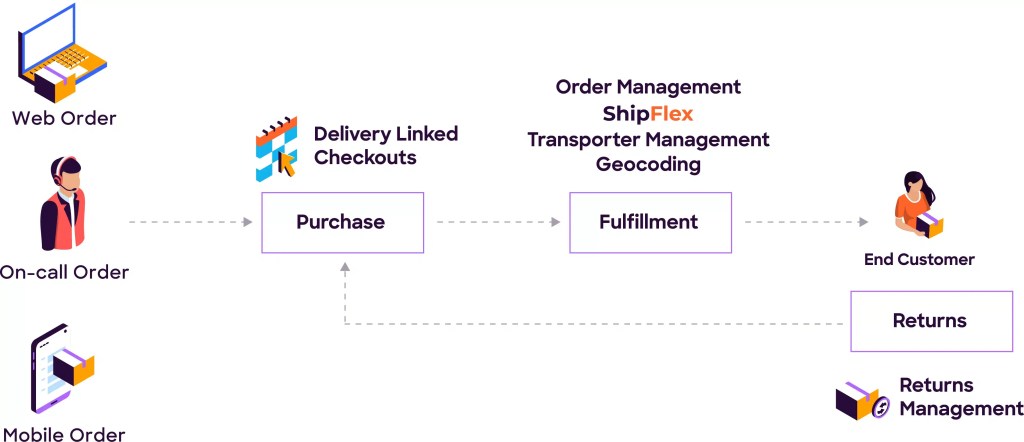
Over time, we were able to create just these kind solutions across major operations of the value chain. For example, at the purchase stage, we also have developed solutions like Delivery Linked Checkout, which maximizes the convenience of fulfillment for consumers with multiple delivery options.
Similarly, at the dispatch stage order management has also been benefitted from automated decision-making, ensuring assignment incoming on-demand orders to the most appropriate driver in real time, based on driver shift information and availability. Similar, it can enable returns.
Our Geocoding solution is able to convert unclear addresses into precise latitudes and longitudes, instrumental to reducing First Attempt Delivery Rates (FADR), maintaining a 99.5% on-time delivery service levels, and keeping the calls to customers at a minimum, which significantly improves their fulfillment experience. More of which we will outline in our upcoming blogs.
Connecting the dots with a data-first approach
Central to achieving this kind of excellence is maintaining a data-based approach. As the saying goes, “You cannot improve what you cannot measure.” By embellishing these solutions with AI or ML capabilities, we empower them to learn from the massive data sets that we have gathered over the past decade. The larger the data set, the more insights it is able to glean from the various scenarios of the past, and thus the more optimal the outcome.
This has been key to empowering our clients to bring more sustainability to their operations. By keeping track of the carbon emissions, businesses can be cognizant of the impact on the environment, and strive to prioritize routes order batching that has a lower impact on the environment, while keeping costs in check.
While it is not strictly a solution where we use AI and ML, we also offer our clients Business Insights to uncover hidden inefficiencies and new growth opportunities through intuitive dashboards.
Keeping the people on the ground, front and center
Intuitiveness is also one of the concepts that we have revisited on a first principles basis. Just what does it mean when an experience is intuitive? This was a crucial question in the context of change management, arguably one of the biggest challenges to tech adoption and seeing efficiencies at scale. The learning curve for using new solutions on the ground is often why businesses see delayed returns on their investments.
We revisited the assumption that a User Interface (UI) is the most intuitive User Experience (UX) for handling complicated management systems on the ground, whether it be a TMS,OMS, WMS or a complex ERP. What we have forgotten is that most of us been privileged enough have spent years in working on such interfaces in some form or the other. That said, even this does not guarantee in eliminating the learning curve altogether.
Taking cues from the possibilities of Large Action Models (LAMs), we realized that nothing can be more intuitive that the human speech. We envision solutions that leverage human speech commands as changing the face of change management in the future, and we are excited to continue to explore the possibilities in this relatively unchartered territory.
While we continue to look at empowering workers on the ground, our team is equally excited to be exploring LLMs to enhance their own productivity, whether it streamlining coding processes with Github, or facilitating information gathering and exchange with LLMs that retrieve data from multiple knowledge sources.
Reimagining new futures with AI-backed solutions
At Locus, we were able to see concrete benefits from deploying AI-backed solutions by understanding the problem statement on a first principles basis, deeply understanding how AI and ML technologies work, and prioritizing focus areas where they can truly make a difference.
In the next part of the “AI in Action” series, we will take a closer look at some of the individual solutions that are embellished with some form AI/ML, and the kind of outcomes they were able to generate.
We hope you found this blog insightful. If you are interested in knowing how to scale efficiency, agility and resilience across your logistics operations, you reach out to our experts here.

Fleet Optimization
Cross Fleet Utilization: Key Aspects & Importance in 2025

Sep 1, 2025
Discover what is cross fleet utilization in 2025—key aspects, benefits, and strategies to maximize efficiency, cut costs, and boost ROI in logistics and transport
Read more
E-Commerce
Last Mile in E-commerce: Definition, Importance & Benefits

Sep 10, 2025
Consumers all over the globe want quick, almost instant deliveries. As quick commerce becomes normal, the competition to ensure quick deliveries also intensifies. In this chaos, retailers and business owners wanting to gain market share must fine tune their last-mile fulfilment. Every eCommerce order may begin with a click, but the real test lies in […]
Read moreInsights Worth Your Time


SUBSCRIBE TO OUR NEWSLETTER
Stay up to date with the latest marketing, sales, and service tips and news
AI in Logistics: What is It? Why It Matters in 2025?